/
/

In the rapidly evolving electronics industry, the intersection of circular economy and fire safety has become a critical focal point for engineers and procurement professionals. As global regulations like the European Green Deal and EPEAT push for higher recycled content in consumer electronics, the challenge shifts to maintaining rigorous safety standards—specifically flame retardancy.
Transitioning from virgin resins to Post-Consumer Recycled (PCR) or Post-Industrial Recycled (PIR) materials often raises concerns regarding consistency and safety compliance. Can a recycled ABS or PC/ABS blend truly provide the same level of protection as its virgin counterpart? The answer lies in advanced compounding technology and strict adherence to GRS (Global Recycled Standard) protocols.
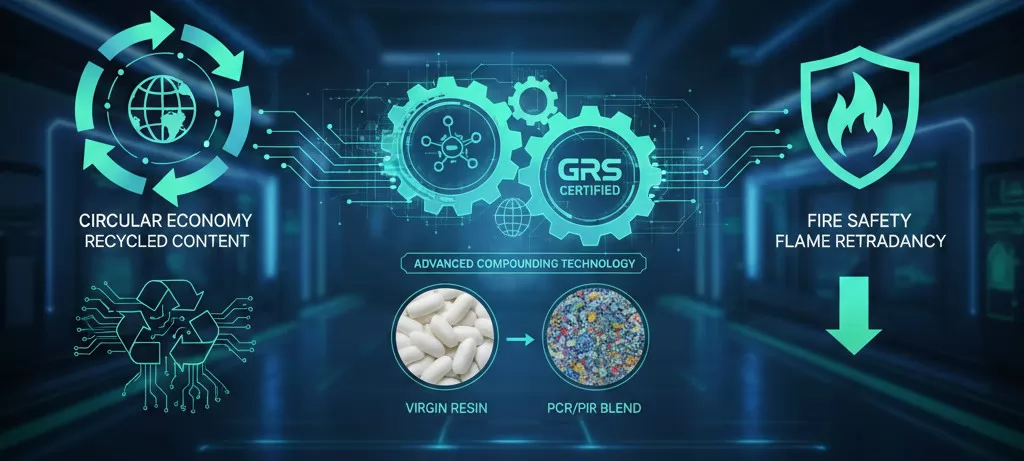
Electronics are inherently susceptible to thermal stress. For materials like r-ABS, r-PC, and r-PP, achieving a flame-retardant (FR) rating is not just a value-add—it is a mandatory requirement for entering global markets. Key drivers include:
| Material Type | Base Resin Source | Key Electronic Applications |
|---|---|---|
| r-ABS | PCR Electronic Waste | Monitor frames, keyboard keys, router housings. |
| r-PC/ABS | Industrial Scraps / PCR | Laptop covers, automotive electronics, battery packs. |
| r-PP | Packaging / Industrial | Internal structural parts, capacitor shells. |
For any electrical component, fire safety is non-negotiable. The UL94 standard (Standard for Safety of Flammability of Plastic Materials for Parts in Devices and Appliances) remains the global benchmark. When working with r-PC, r-ABS, or r-PP, achieving a consistent UL94 rating is more complex than with virgin resins due to the potential variability in the source material’s molecular weight.
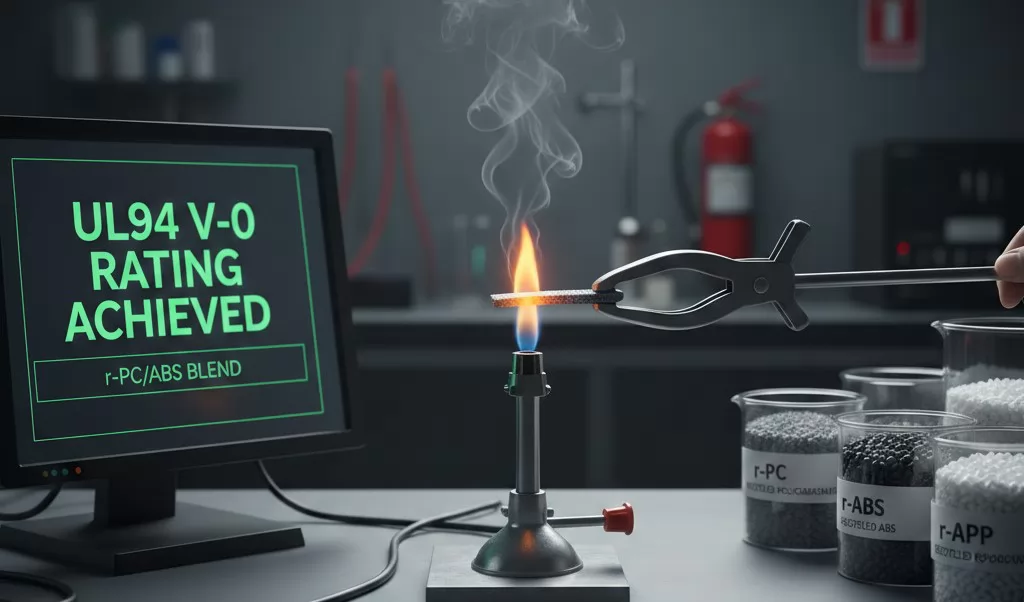
Our flame retardant recycled solutions are specifically engineered to meet the top tiers of the UL94 hierarchy. For electronic enclosures and internal structural parts, we primarily focus on:
| Rating | Testing Criteria (Vertical Burn) | Target Application |
|---|---|---|
| V-0 | Burning stops within 10 seconds; no flaming drips allowed. | High-risk electronics, power adapters, EV charging components. |
| V-1 | Burning stops within 30 seconds; no flaming drips allowed. | Internal structural components, industrial switchgear. |
| V-2 | Burning stops within 30 seconds; flaming drips are permitted. | Non-critical consumer goods, low-voltage battery covers. |
Unlike r-PC (Recycled Polycarbonate), which has an inherent degree of flame resistance, base r-ABS and r-PP are highly flammable. Achieving V-0 at 1.5mm or 0.8mm thickness in these materials requires sophisticated additive synergy—ensuring that the flame retardants are uniformly dispersed throughout the recycled matrix without compromising the material's structural integrity.
In the B2B procurement cycle, having a UL Yellow Card for recycled grades is a massive advantage. It proves that the r-PC/ABS or r-PP has undergone rigorous testing and maintains its safety properties even after being reprocessed. For brands aiming for GRS certification, this documentation provides the final layer of trust needed to integrate recycled content into mass-produced electronic devices.
The primary technical hurdle for Recycled Flame Retardant (FR) Plastics is the "Degradation Loop." Each time a polymer like r-PC or r-ABS is reprocessed, its molecular chains undergo thermal-mechanical shearing, which can reduce its mechanical strength and flame retardancy efficiency.
Our compounding process breaks this cycle through molecular reconstruction and precision additive dosing. For GRS-certified materials, we ensure that the recycled content retains 95% or more of its original physical properties while achieving UL94 V-0 performance.
We use high-efficiency compatibilizers to bridge the gap between different batches of r-PC/ABS. This ensures a uniform morphology, preventing delamination and maintaining flame retardant distribution.
By combining Phosphorus-based and Nitrogen-based flame retardants, we create a "char-forming" layer that acts as a thermal barrier, even when the r-PP or r-ABS base has a lower starting viscosity.
Traditional flame retardants often make recycled plastics brittle. To counter this, our r-PC/ABS and r-PC grades incorporate specialized impact modifiers. This allows the material to pass the UL94 V-0 vertical burn test while maintaining high IZOD notched impact strength—a critical requirement for electronic housings that must survive drop tests.
For high-performance r-PC, we employ chain extension agents that chemically "repair" broken molecular chains. This increases the melt flow index (MFI) stability, ensuring that during the injection molding of thin-walled electronic parts, the flame retardant properties remain consistent from the first shot to the last.
Key Advantage: Our materials are tested using TGA (Thermogravimetric Analysis) to ensure thermal stability during high-temperature processing, preventing the release of corrosive gases that could damage precision molds.
Choosing the right recycled resin involves balancing mechanical strength, flame retardancy, and cost-effectiveness. In the electronics sector, r-PC (Polycarbonate) and r-ABS (Acrylonitrile Butadiene Styrene) are the two most common contenders, each offering distinct advantages for housing and structural parts.
The following table outlines the typical performance benchmarks for our GRS-certified flame retardant recycled materials at a standard 1.5mm thickness:
| Property | r-ABS (FR) | r-PC (FR) | r-PC/ABS (FR) |
|---|---|---|---|
| UL94 Rating | V-0 / V-1 | V-0 (Up to 5VA) | V-0 |
| Impact Strength | Moderate | Very High | High |
| Heat Deflection (HDT) | ~85°C | ~125°C | ~105°C |
| Surface Finish | High Gloss | Transparent/Opaque | Excellent Satin |
| Cost Index | ★☆☆☆☆ (Budget) | ★★★☆☆ (Premium) | ★★☆☆☆ (Balanced) |
*Data based on typical PCR batches. Custom compounding available for specific high-impact requirements.
r-ABS is the go-to solution for cost-sensitive consumer electronics like router housings, remote controls, and household appliance covers. It offers excellent processability and a high-quality surface finish, making it ideal for aesthetics-driven products that still require UL94 V-0 safety.
When transparency or extreme heat resistance is required, r-PC is superior. It is widely used in LED lighting components, high-voltage industrial switchgear, and items that must withstand significant physical impact.
For many premium laptop manufacturers and automotive electronics suppliers, r-PC/ABS is the preferred alloy. It combines the impact resistance and heat stability of PC with the easy flow and cost-efficiency of ABS. It is the industry standard for thin-wall molding where flame retardancy cannot be compromised.
Application Tip: For internal components where aesthetics are secondary, r-PP (Recycled Polypropylene) with halogen-free flame retardants offers the lowest density and best chemical resistance, significantly reducing the overall weight of the device.
For international OEMs, a material's "green" credentials are as important as its technical specs. When using Flame Retardant Recycled Plastics, the biggest risk is the presence of restricted legacy additives—substances like lead, cadmium, or certain brominated flame retardants (PBDEs/PBBs) found in older generations of plastic waste.
To ensure our r-PC, r-ABS, and r-PC/ABS compounds are fully compliant with global markets, we implement a multi-stage testing protocol. Every batch of incoming GRS-certified feedstock is screened to meet the following standards:
We guarantee that our r-PP and other recycled resins contain less than the mandated limits for heavy metals and phthalates. This is especially critical for r-ABS sourced from electronic waste (WEEE), where specialized sorting technology is used to remove non-compliant fragments.
With the REACH Candidate List of Substances of Very High Concern (SVHC) updated semi-annually, our lab continuously monitors our r-PC/ABS formulations. We ensure that no SVHC is present in concentrations above 0.1% (w/w), providing full transparency for your supply chain audits.
Many modern electronics projects now specify Halogen-Free Flame Retardant (HFFR) materials to avoid the release of toxic smoke during combustion. We offer specialized HFFR grades of r-PC and r-PP that utilize phosphorus-nitrogen synergy to achieve UL94 V-0 without the use of chlorine or bromine.
Our Global Recycled Standard (GRS) certification is not just about the percentage of recycled content. It also mandates strict social and environmental practices, as well as chemical restrictions that go beyond standard industrial requirements. When you source our FR recycled plastics, you receive a Transaction Certificate (TC) that proves the material’s lineage and safety compliance.
In the world of polymer engineering, there is a traditional "tug-of-war" between flame retardancy and mechanical toughness. High concentrations of flame retardant (FR) additives often act as stress concentrators, significantly reducing the Notched Izod Impact Strength. For r-ABS and r-PC/ABS, this challenge is amplified by the inherent variability of recycled feedstocks.
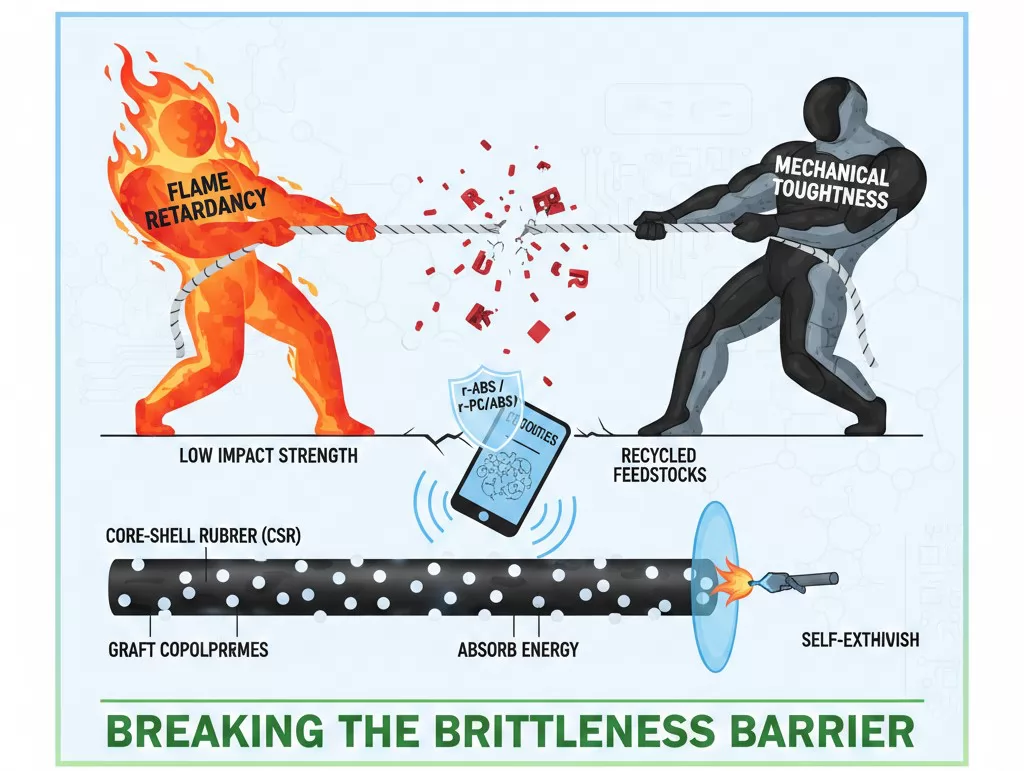
Our R&D team utilizes Core-Shell Rubber (CSR) impact modifiers and specialized graft copolymers to restore the lost toughness in recycled resins. This ensures that the material can absorb energy during a sudden impact (like a device being dropped) without cracking, while still extinguishing a flame within seconds.
By optimizing the additive package, we achieve near-virgin performance levels in our FR grades:
Modern electronics, such as smartphone internals and laptop bezels, require thin-wall molding (often down to 0.8mm or 1.0mm). At these thicknesses, achieving UL94 V-0 is exceptionally difficult for r-PP and r-ABS.
We solve this by using Hyper-branched polymers that improve melt fluidity without degrading molecular weight. This allows the FR recycled plastic to fill complex molds completely while maintaining a uniform protective "char-layer" during combustion tests.
The most common concern for electronics manufacturers when switching to Recycled Flame Retardant Plastics is consistency. Unlike virgin resins, recycled feedstocks like r-ABS and r-PC come from various post-consumer sources. Without a robust Quality Control (QC) system, this can lead to fluctuations in melt flow, color drift, and unpredictable flame retardant performance.
To ensure our GRS-certified materials perform reliably in high-speed injection molding lines, we implement a closed-loop quality management system:
We provide a detailed COA for every shipment of flame retardant recycled granules. Our internal lab focuses on these critical metrics:
By maintaining this rigorous overhead on production, we allow our customers to treat r-ABS and r-PC/ABS just like virgin materials, with no need for constant machine recalibration.
The versatility of our Flame Retardant Recycled Plastics allows them to be used across a broad spectrum of electronic and electrical (E&E) applications. By matching specific polymer grades to the functional requirements of the end product, we help brands achieve their sustainability goals without compromising on safety.
Material: r-ABS / r-PC/ABS (V-0)
Requires high-gloss surface finish and excellent signal transparency. Our r-ABS provides the perfect balance of aesthetics and fire protection.
Material: r-PC/ABS (High Impact V-0)
Thin-wall designs demand high melt flow and superior impact resistance to survive drop tests while meeting UL94 standards.
Material: r-PC / r-PP (V-0/V-2)
Focuses on chemical resistance and thermal stability. r-PC is ideal for transparent covers requiring high heat deflection temperatures.
Material: r-PC (V-0 / 5VA)
Extreme safety requirements for high-voltage components. Our r-PC grades ensure 5VA performance to prevent fire propagation.
As the EV market grows, the demand for r-PC/ABS in internal charging station components has surged. Our GRS-certified materials provide the weatherability and flame retardancy needed for both indoor and outdoor charging environments.
For smaller IoT devices, r-PP with halogen-free flame retardants offers a lightweight, moisture-resistant housing solution. Its low density helps in reducing the overall shipping weight, further contributing to carbon footprint reduction.
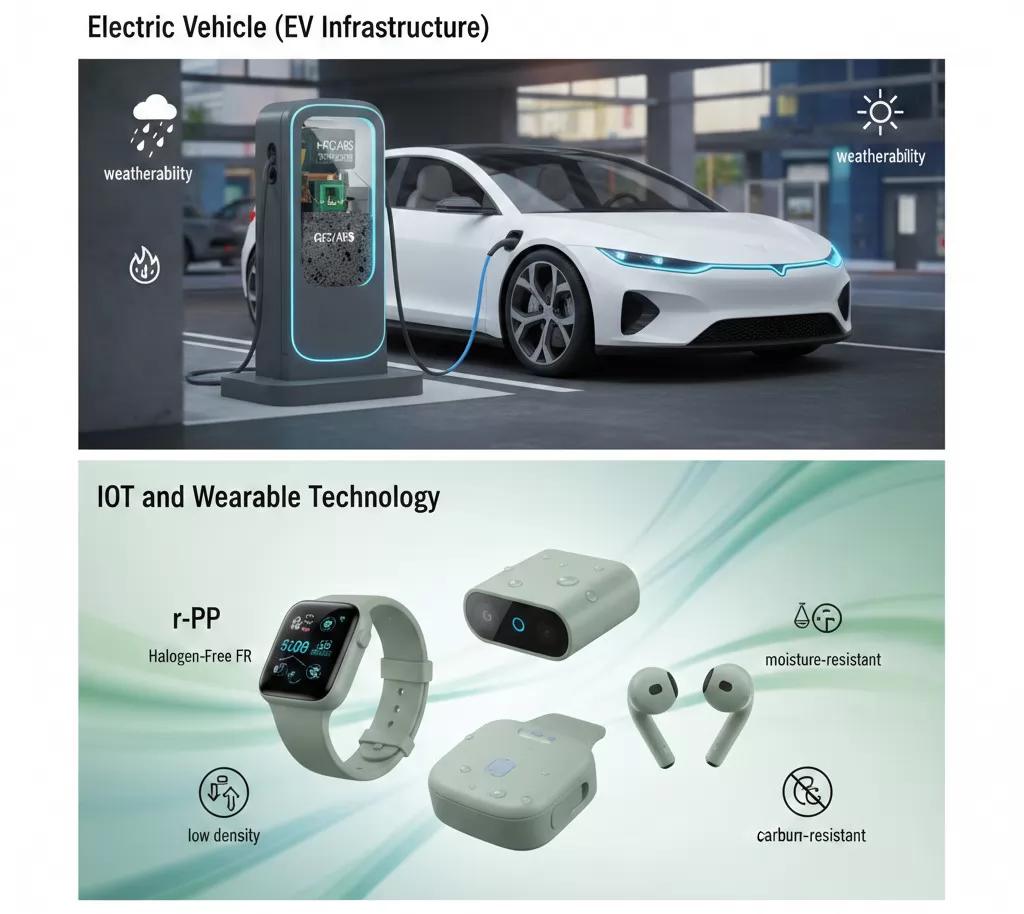
Engineering Support: Not sure which material fits your application? Our technical team provides mold flow analysis and material selection workshops to ensure a seamless transition to recycled content.
In the sustainable plastics industry, "greenwashing" is a significant concern for global brands. To mitigate this risk, GRS (Global Recycled Standard) has become the gold standard for verifying the recycled content of plastics like r-PC, r-ABS, and r-PP. It provides a transparent chain of custody from the initial waste collection to the final compounded pellet.
Our GRS certification (and the resulting Transaction Certificates) covers more than just the material origin. It guarantees four critical factors:
For our B2B partners, the most vital document is the Transaction Certificate (TC). This isn't just a general factory certificate; it is a shipment-specific document that proves the Flame Retardant r-PC/ABS you receive is authentically recycled.
Major electronics retailers and government procurement agencies now demand "verified recycled content" to meet carbon neutrality targets. Using our GRS-certified r-PP or r-ABS allows your products to:
By choosing a GRS-certified partner, you are not just buying plastic; you are securing the integrity of your brand's sustainability claims. We provide all necessary documentation to support your environmental audits and ESG reporting.
As the global electronics market moves toward a non-toxic circular economy, the demand for Halogen-Free Flame Retardant (HFFR) solutions is skyrocketing. While traditional brominated flame retardants are highly effective, their environmental persistence and potential for toxic byproduct release during incineration have led to stricter bans under RoHS and REACH.
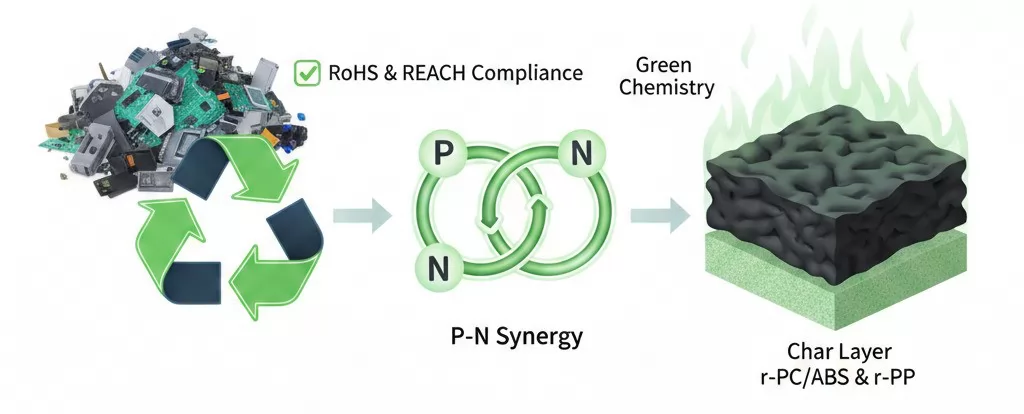
The next generation of r-PC/ABS and r-PP is designed using Phosphorus-Nitrogen (P-N) synergy. These HFFR systems work by forming a stable, expanded carbonaceous layer (char) that insulates the underlying polymer from oxygen and heat.
AI-driven sorting technology is now allowing us to separate r-ABS from complex e-waste with 99.9% purity. Furthermore, chemical recycling (depolymerization) is emerging as a way to turn heavily contaminated plastic waste back into virgin-quality r-PC, ensuring infinite recyclability.
With the miniaturization of 5G devices and IoT sensors, materials must achieve UL94 V-0 at 0.4mm to 0.6mm. Our R&D is currently perfecting nano-clay reinforced r-PC/ABS blends that provide superior flame quenching in ultra-thin profiles.
Beyond standard PCR, brands are now seeking Ocean-Bound Plastics. We are developing FR-grade r-PP and r-ABS sourced from coastal regions, offering a powerful storytelling element for eco-conscious consumer products.
Strategic Conclusion: The transition to Flame Retardant Recycled Plastics is no longer a compromise—it is a competitive necessity. By combining UL94 safety, GRS traceability, and mechanical durability, our materials empower you to lead the green revolution in the electronics industry.
As a leading GRS-certified manufacturer, we specialize in high-performance engineering plastics for the global electronics industry. Our facility combines advanced compounding technology with a rigorous ISO-certified lab to ensure every batch of r-PC, r-ABS, and r-PP meets the world's toughest safety standards.
Get a technical data sheet (TDS) or request a sample for your next project.
Request a Quote & Samples
Discover this amazing content and share it with your network!

Topcentral leads UK recycled plastics in 2026 with innovative, sustainable solutions driving circular economy growth and industry excellence.

How to calculate and compare carbon footprints of recycled vs virgin plastics — ISO 14067 methodology, allocation methods, polymer-by-polymer emission factors, and CSRD Scope 3 Category 1 reporting using PCFNow platform data.

GRS Transaction Certificate vs ISCC PLUS Proof of Sustainability — a procurement decision guide for PCR plastic material buyers covering industry acceptance, document formats, UL 2809, and PPWR Article 16 compliance.