/
/

rPC (recycled polycarbonate) is a post-consumer recycled engineering thermoplastic produced by collecting, sorting, and reprocessing end-of-life PC products — including water buckets, optical disks, and lamp covers — into specification-grade pellets or compounds. Quality rPC retains the core properties of virgin PC: high impact strength, optical clarity, and heat resistance, making it a functionally viable and lower-carbon alternative for electronics, automotive, and consumer goods applications.
Table of Contents
Polycarbonate (PC) is a high-performance engineering thermoplastic built around bisphenol A (BPA) monomer units linked by carbonate groups. Its combination of high impact resistance, optical transparency, dimensional stability, and heat resistance makes it one of the most widely specified engineering plastics across electronics, automotive, medical, and construction applications. Virgin PC is produced from petrochemical feedstocks through energy-intensive polymerization — it carries significant embodied carbon and tracks crude oil pricing in global markets.
Recycled polycarbonate (rPC) is the same polymer as virgin PC, produced from post-consumer and post-industrial PC waste streams rather than from petrochemical feedstocks. The two materials share the same molecular backbone; the difference is entirely in the origin of the polymer chains. This distinction is commercially and regulatorily significant: PCR PC® qualifies as post-consumer recycled (PCR) content under GRS, ISCC PLUS, and UL 2809 certification schemes, and counts toward PCR content targets set by the EU ESPR, ELV Directive, and similar regulations.
The terminology used in procurement and sustainability documentation varies by region and standard:
The "r" prefix matters beyond labeling. In EPD documentation and Scope 3 emissions calculations, recycled polycarbonate carries a substantially lower embodied carbon factor than virgin PC. In supplier qualification for electronics OEMs and automotive Tier 1 suppliers, PCR polycarbonate with a certified PCR content declaration is a qualifying material under recycled content mandates. In product carbon footprint (PCF) calculations, the difference between virgin PC and post-consumer polycarbonate as feedstock material directly affects the PCF output — a difference that Topcentral's PCFNow carbon footprint platform quantifies and documents at the batch level for each PCR PC® production run.
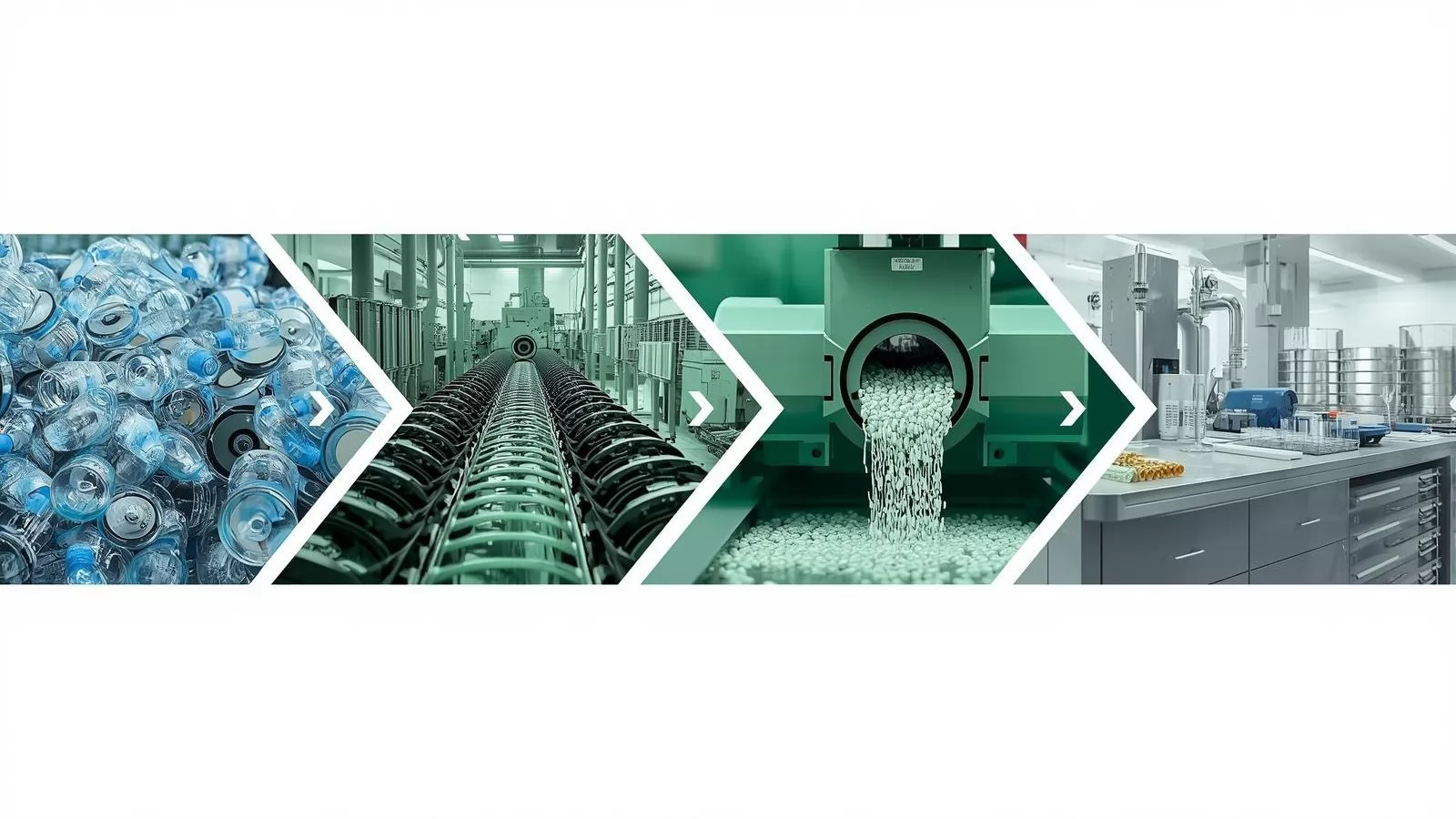
The quality gap between specification-grade rPC and generic regrind originates entirely in the processing chain. Producing recycled polycarbonate that consistently meets injection molding or extrusion grade specifications requires controlled processing at every step — from waste stream selection through final quality verification. Topcentral's PCR PC® product line is produced through a four-stage process that treats each step as a quality control point, not merely a handling operation.
PC waste streams vary significantly in molecular weight, color consistency, and contamination profile depending on their original application. The primary post-consumer PC sources processed by Topcentral include drinking water buckets and bottles, transparent sheets, lamp covers, transparent containers, optical lenses, and CD/VCD/DVD disks. Automotive-source PC — headlamp housings, instrument cluster lenses, interior trim panels — forms a distinct high-quality stream processed under Topcentral's ReAutoLoop® Technology, which maintains closed-loop traceability from automotive dismantler to finished rPC pellet.
Source stream selection directly determines the ceiling on achievable material properties. Optical-grade PC from lens or disk sources carries higher initial molecular weight and lower contamination than mixed post-consumer streams, enabling production of transparent rPC grades such as PC-GT02A and PC-103AR with optical clarity suitable for consumer and toy applications. Mixed opaque streams are better suited to black or colored compound production such as PC-2010BK.
Incoming PC waste is sorted by color, transparency grade, and contamination level before processing begins. Non-PC contaminants — labels, adhesive residues, metal inserts, other polymer fractions — are removed at this stage. Mixed polymer contamination is particularly damaging in PC processing: even small fractions of incompatible polymers such as PET or PVC produce visible inclusions, reduce impact strength, and cause processing instability.
Washing and drying follow sorting. PC is hygroscopic — it absorbs atmospheric moisture readily, and residual moisture above approximately 200 ppm in the feed material causes hydrolytic degradation during melt processing. Hydrolysis cleaves the ester linkages in the PC backbone, reducing molecular weight, lowering impact strength and heat resistance, and producing surface defects including silver streaking and splay marks in molded parts. Pre-drying to specification moisture levels before extrusion is therefore a non-negotiable processing step, not an optional quality measure.
Dried, sorted PC is processed through a twin-screw extruder under controlled temperature and shear conditions to produce uniform pellets. PC undergoes chain scission — irreversible reduction in molecular weight — when exposed to excessive heat or shear during melt processing. Processing temperature profiles must be precisely controlled to minimize chain scission while achieving sufficient melt homogeneity. The resulting pellets carry a lower molecular weight distribution than the original material; the extent of reduction depends on source material quality and processing control.
Stabilizer and additive packages are incorporated during compounding to restore processing characteristics and thermal stability. These typically include thermal stabilizers to protect against oxidative degradation during subsequent processing by the customer, UV stabilizers for outdoor or light-exposed applications, and lubricants to optimize flow behavior. The additive system is formulated to match the intended processing method — injection molding grade rPC receives a different additive package than extrusion grade, reflecting the different shear rates, dwell times, and mold release requirements of each process.
Finished PCR PC® pellets undergo property enhancement compounding where required — flame retardant packages for UL94-rated grades, glass fiber reinforcement for structural compound grades, or colorant incorporation for custom color specifications. Each production batch is verified against specification parameters including MFI consistency, color measurement (CIELAB coordinates), contamination screening, and mechanical property spot-checks. Topcentral's recycled polycarbonate pellets (PCR PC®) and recycled PC compounds (CircleBlend®) are produced under this quality system — the distinction from generic regrind is the consistency of specification compliance batch to batch, not merely the polymer identity.
The commercial question procurement engineers ask is not whether recycled polycarbonate is identical to virgin PC — it is not, at the molecular level — but whether it performs adequately for the specific application and processing conditions in question. For the majority of non-structural injection molding and extrusion applications, quality PCR PC® from a controlled source and processing chain is a functionally equivalent substitute for virgin PC. The properties that matter for each application class are examined below.
Quality Quality recycled PC retains high impact resistance and tensile strength relative to the virgin PC benchmark. The magnitude of the retained-property gap depends on source material molecular weight and processing quality — specifically, the degree of chain scission during melt processing. Post-consumer polycarbonate processed from high-molecular-weight source streams under controlled conditions delivers impact performance that meets the requirements of electronics housing, appliance panel, and automotive trim applications. For applications requiring maximum notched impact strength — thick-section structural parts under dynamic loading — the specific grade datasheet should be consulted. Contact Topcentral for grade recommendations and mechanical property data for your application.
Heat deflection temperature (HDT) and Vicat softening point are largely retained in quality recycled polycarbonate produced from well-controlled source streams. Molecular weight reduction during processing does reduce thermal performance — lower molecular weight PC softens at lower temperatures — which is why source stream selection and processing condition control directly determine the thermal ceiling of the finished recycled PC grade. For applications with HDT requirements above approximately 120°C, grade datasheet verification is required.
Transparent PCR PC® grades achieve high light transmission when produced from optically clear source streams — optical lens-grade PC, clear water bottle PC, or disk-grade PC — and processed under conditions that minimize yellowing and haze generation. Topcentral's PC-GT02A (blue transparent, FreeCBO2® Technology) and PC-103AR (transparent, toy safety compliance) are produced from selected clear source streams to maintain optical performance requirements. For applications where haze and yellowness index (YI) are specification parameters, grade-specific optical data should be verified before commitment against the chosen PCR PC® grade datasheet.
Recycled polycarbonate carries substantially lower embodied carbon than virgin PC. Virgin polycarbonate production is energy-intensive and petrochemical-derived — its carbon footprint reflects both the extraction and processing of fossil feedstocks and the energy consumption of polymerization. PCR PC® avoids the virgin polymerization step entirely; its carbon footprint covers collection, sorting, pre-treatment, and reprocessing — a materially smaller energy expenditure. Topcentral's FreeCBO2® Technology and PCFNow carbon footprint platform provide documented product carbon footprint figures per kilogram of rPC at the batch level — enabling procurement teams to use verified PCF data in Scope 3 calculations and EPD filings rather than generic emission factors.
| Property | Virgin PC | Quality rPC (PCR PC®) | Notes |
|---|---|---|---|
| Impact Strength | High (benchmark) | High — retained in quality grades | Verify datasheet for structural applications |
| Heat Resistance (HDT) | High (benchmark) | Largely retained; source-dependent | Molecular weight management critical |
| Transparency | High optical clarity | Retained in clear-source grades (PC-GT02A, PC-103AR) | Source stream selection determines optical ceiling |
| CO₂ Footprint | Higher (petrochemical origin) | Substantially lower — documented via PCFNow | FreeCBO2® Technology; batch-level PCF available |
| Price | Tracks crude oil pricing | Typically lower; more stable pricing | Varies by grade and volume |
| Regulatory Compliance Readiness | Does not qualify for PCR mandates | GRS / ISCC PLUS / UL 2809 certifiable | Supports EU ESPR, ELV, EPR compliance |
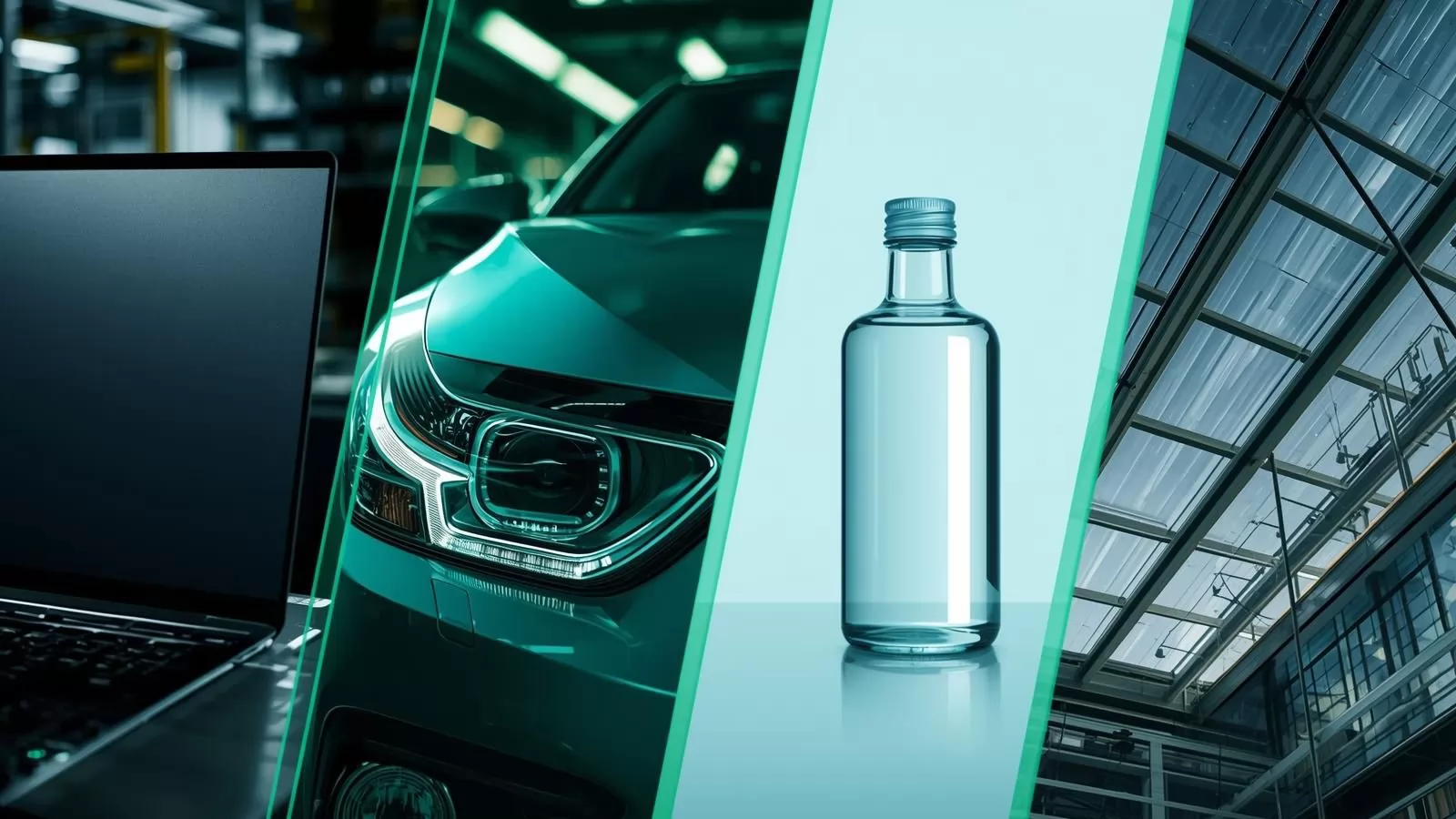
Polycarbonate's combination of impact resistance, heat resistance, and optical clarity established it across four major industrial application sectors. As PCR content mandates tighten and Scope 3 reporting requirements expand, material procurement teams in each sector are actively qualifying rPC as a direct replacement for virgin PC in existing tooling and processes.
Electronics and Electrical Equipment (EEE)
PC is the standard housing material for laptop computers, monitor bezels, printer enclosures, power tool housings, and electrical junction boxes — applications where the combination of impact resistance, UL94 flame retardancy, and dimensional stability is required. EU WEEE regulations and the forthcoming ESPR (Ecodesign for Sustainable Products Regulation) are establishing minimum PCR content requirements for plastic components in electronics and electrical products. Recycled PC with documented recycled content (GRS or ISCC PLUS certified) and batch-level carbon footprint data from Topcentral's PCFNow platform directly satisfies both the PCR content declaration and the carbon footprint documentation that ESPR compliance requires. Topcentral's ITEcycle® product positioning addresses exactly this OEM qualification pathway for electronics and appliance applications — providing ITE-sector-specific recycled polycarbonate grades with the certification and documentation package that electronics procurement requires.
Automotive
PC's optical clarity, impact resistance, and heat resistance make it the material of choice for headlamp outer lenses, instrument cluster covers, interior trim panels, and — increasingly — charge port covers and battery module components in electric vehicles. The EU End-of-Life Vehicle (ELV) Directive revision currently progressing through the EU legislative process will establish mandatory recycled content targets for plastic components in new vehicles, targets that automotive Tier 1 suppliers are now preparing for in their material qualification processes. Topcentral's ReAutoLoop® Technology addresses this requirement directly: it processes automotive-source PC waste — including headlamp housings and interior panels from vehicle dismantlers — back into specification-grade PCR PC® pellets with full source traceability. The PC-2010BK grade (black recycled PC from automotive sources) represents a production-ready automotive-loop recycled polycarbonate option for procurement teams beginning closed-loop qualification programs.
Consumer Products and Appliances
Water dispensers, food-grade containers, small appliance housings, and storage products represent significant volume applications for injection-grade PC. For applications where optical clarity is a product requirement — water dispenser reservoirs, food storage containers with transparent lids, beauty product packaging — transparent PCR PC® grades are the relevant specification. PC-GT02A (blue transparent, FreeCBO2® Technology) and PC-103AR (transparent, toy safety compliance) are qualified for consumer applications requiring maintained optical performance. PC-103AR specifically addresses toy and children's product applications where safety compliance documentation — REACH, RoHS, and toy standard compliance — is a procurement requirement in addition to material performance.
Building and Construction / Glazing
Polycarbonate sheet is used in safety glazing, skylight panels, greenhouse glazing, and noise barrier panels — applications that exploit PC's high impact resistance and light transmission. Extrusion-grade recycled polycarbonate supports these applications, where the production process is sheet or profile extrusion rather than injection molding and the relevant MFI specification differs accordingly. PCR PC® compounds with reinforcement — available in Topcentral's recycled PC alloy compounds range — address structural glazing support and curtain wall component applications where both mechanical performance and lower-carbon material credentials are required.
Procurement decisions on recycled polycarbonate are increasingly driven by regulatory compliance requirements and corporate sustainability commitments rather than purely by material cost. The regulatory and commercial drivers reinforcing each other create a strong and durable case for PCR PC® specification that goes beyond green marketing positioning.
EU ESPR (Ecodesign for Sustainable Products Regulation): The ESPR, which entered into force in 2024 and is establishing product-specific implementing regulations, sets minimum recycled content requirements for plastic components across electronics, textiles, and other product categories. Electronics OEMs supplying the EU market need to document PCR content in plastic housings — recycled polycarbonate with GRS or ISCC PLUS certification and a recycled content declaration satisfies this documentation requirement.
EU ELV Directive Revision: The revised End-of-Life Vehicles Directive targets mandatory minimum recycled content percentages for plastics in new vehicles sold in the EU. Automotive Tier 1 suppliers are currently building qualification files for recycled PC grades from traceable sources — particularly automotive closed-loop sources such as those accessed through Topcentral's ReAutoLoop® Technology — to support OEM compliance submissions.
Extended Producer Responsibility (EPR) and Plastic Taxes: The UK Plastic Packaging Tax, currently set at £217 per tonne for plastic packaging containing less than 30% recycled content, creates a direct financial cost for virgin plastic use. Similar fiscal mechanisms are advancing in EU member states and other markets. Virgin PC used in packaging-adjacent applications increasingly carries a measurable tax cost that post-consumer recycled PC avoids.
Carbon Border Adjustment Mechanism (CBAM): EU CBAM applies carbon pricing to imports of carbon-intensive materials from countries without equivalent carbon pricing. While CBAM's current scope covers specific sectors, its expansion trajectory covers high-embodied-carbon materials — virgin PC's petrochemical origin and energy-intensive production places it in the category of materials that will face increasing carbon cost exposure over the policy horizon.
Corporate Scope 3 emissions reduction commitments — now standard in CDP disclosures and SBTi (Science Based Targets initiative) pathways for major branded manufacturers — require reducing the embodied carbon of purchased materials. Virgin PC's petrochemical-derived carbon footprint sits entirely in Scope 3 Category 1 (Purchased Goods and Services). Switching to recycled polycarbonate with a documented lower PCF directly reduces the Category 1 Scope 3 emissions figure that appears in CDP filings and annual sustainability reports.
Topcentral's Topcentral's sustainability framework — including the Back2Circle traceability platform and PCFNow product carbon footprint platform — provides the quantified material-level PCF data that sustainability reporting teams need to populate Scope 3 calculations accurately. GRI Standard 301 (Materials) requires disclosure of recycled input materials by weight — PCR PC® supply with a GRS or ISCC PLUS certificate supports this disclosure directly.
PCR polycarbonate is typically priced below virgin PC on a per-kilogram basis, with the price differential reflecting the different feedstock and processing cost structures. For high-volume injection molding operations running engineering plastic parts, the material cost saving per kilogram compounds significantly across annual production volumes. PCR PC® pricing also exhibits lower correlation to crude oil price movements than virgin PC, which reduces exposure to energy market volatility in material budgeting. For procurement managers building the internal business case for recycled polycarbonate specification, the combination of regulatory compliance cost avoidance, Scope 3 reporting benefit, and direct material cost reduction typically produces a straightforward total-cost-of-ownership justification for PCR PC® specification.
PCR PC® is not a single material — Topcentral's product ranges span injection grades, extrusion grades, flame-retardant compounds, reinforced compounds, alloy compounds, and custom color formulations. Correct grade selection requires working through four specification dimensions in sequence.
Dimension 1 — Processing Method
Injection molding grade, extrusion grade, and blow molding grade PCR PC® carry different MFI specifications because each process imposes a different shear rate and residence time on the melt. An injection molding grade with a high MFI (low viscosity) will not produce adequate melt strength for extrusion sheet production; an extrusion grade with low MFI will generate excessive injection pressure and cycle time in injection molding. Confirm the intended processing method before requesting a grade recommendation — Topcentral supplies all three processing grades within the PCR PC® product family.
Dimension 2 — Optical and Color Requirements
The optical specification drives source stream selection as much as any processing parameter. If the application requires water-clear transparency — food containers, medical device housings, optical diffusers — the grade must be produced from high-clarity source streams. Topcentral's PC-103AR (transparent, toy safety compliance) and PC-GT02A (blue transparent, FreeCBO2® Technology) address this requirement. For applications tolerating color or where a specific color match is required, custom colorant compounding is available. Black grades such as PC-2010BK (automotive source, ReAutoLoop® Technology) suit enclosure and structural applications where color is not a transparency requirement.
Dimension 3 — Functional and Performance Requirements
Standard recycled PC does not meet UL94 V0 or V2 flame retardancy ratings inherently — achieving a UL94 flame rating requires flame retardant (FR) additive incorporation in a compound grade. Electronics housings and electrical enclosures with UL94 V0 requirements must specify a CircleBlend® FR variant, not a standard PCR PC® pellet grade. For structural applications requiring higher stiffness and tensile strength than unfilled rPC provides, glass fiber reinforced rPC compound grades are available. For applications requiring specific impact/flow/chemical resistance combinations that unfilled rPC or standard compounds cannot deliver, recycled PC alloy compounds — rPC/ABS, rPC/PBT — address these combination requirements. These alloy grades are available through Topcentral's recycled PC alloy compound product line.
Dimension 4 — Sustainability Documentation Requirements
The certification and documentation package required varies by end market and reporting framework. EU market electronics applications typically require GRS or ISCC PLUS recycled content certification plus a recycled content declaration. Automotive Tier 1 supplier qualification files increasingly require source traceability documentation — available for automotive-source PCR PC® via ReAutoLoop® Technology. ESG reporting and Scope 3 calculations require product carbon footprint data at the material level — available through Topcentral's PCFNow platform. Confirm the documentation package required for your procurement and compliance workflow before placing an order, so that the correct certification and PCF documentation is included with the material shipment.
Need grade selection support? Topcentral's technical team provides grade recommendation assistance based on your application description, processing method, performance requirements, and documentation needs. Contact Topcentral for grade recommendations — send your application brief to Lena.wang@topcentral.cn with your processing method, color requirement, flame retardancy specification, and target market for a matched grade recommendation.
Topcentral supplies PCR PC® recycled polycarbonate pellets and CircleBlend® recycled PC compounds — injection grade, extrusion grade, flame-retardant, reinforced, and custom-color variants. Carbon footprint documentation available via PCFNow platform. GRS / ISCC PLUS / UL 2809 certifiable grades available.
Email: Lena.wang@topcentral.cn | Tel: +86 15990263642
rPC stands for recycled polycarbonate. In plastics industry documentation, the "r" prefix consistently denotes a recycled feedstock origin — rABS is recycled ABS, rPP is recycled polypropylene, and the same convention applies here. The equivalent terms used in certification and sustainability documentation include PCR PC (post-consumer recycled polycarbonate), recycled PC, and post-consumer PC. Topcentral markets its recycled polycarbonate pellet range under the PCR PC® brand designation within the Topcircle® product family. The specific abbreviation in a given document depends on the certification scheme or reporting standard: GRS and ISCC PLUS documentation uses PCR PC; EPD documentation uses recycled PC; material datasheets use rPC as shorthand.
Quality PCR polycarbonate produced from controlled source streams and processed under optimized conditions retains high impact resistance and tensile strength relative to the virgin PC benchmark. The performance gap depends on two factors: the molecular weight of the source material, and the degree of chain scission during melt reprocessing. Post-consumer polycarbonate processed from high-molecular-weight source streams — optical lens PC, automotive headlamp PC — under well-controlled processing conditions is functionally equivalent to virgin PC for the majority of injection molding and extrusion applications, including electronics housings, appliance panels, and automotive trim components. For applications with maximum structural loading or critical impact requirements, the specific grade datasheet should be reviewed. Generic regrind without controlled processing is not a substitute for specification-grade rPC and should not be evaluated as one — contact Topcentral for specific PCR PC® grade mechanical data for your application.
The primary post-consumer PC waste streams processed include drinking water buckets and bottles, transparent sheets, lamp covers, transparent containers, optical lenses, and CD/VCD/DVD optical disks. Automotive-source PC — including headlamp housing outer lenses and interior trim panels from end-of-life vehicles — forms a premium source stream because automotive PC is typically high-molecular-weight and manufactured to tighter original specifications than general consumer PC. Topcentral processes automotive-source PC under its ReAutoLoop® Technology, which maintains full source traceability from dismantler to finished pellet. Source traceability matters because the original application determines the ceiling on achievable material properties: optical-grade PC from disk or lens sources enables transparent recycled polycarbonate grades; mixed opaque PC streams are suited to black or colored compound production.
Standard unfilled PCR PC® pellets do not inherently meet UL94 V0 or V2 flame retardancy ratings. Achieving a UL94 flame rating requires incorporating a flame retardant additive system through a compounding step — the resulting product is a flame-retardant recycled PC compound, not a standard pellet grade. Electronics housings, power strip enclosures, electrical junction boxes, and similar applications typically require UL94 V0 rating, which means the material specification must call for an FR compound grade. Topcentral's CircleBlend® compound range includes flame-retardant variants formulated to meet UL94 V0 requirements. For applications requiring a specific UL94 rating, request the FR grade datasheet and UL Yellow Card reference from Topcentral before finalizing the material specification.
Recycled polycarbonate reduces carbon footprint relative to virgin PC because it avoids the virgin polymerization step, which is the most energy-intensive and carbon-intensive stage of PC production. Virgin polycarbonate is derived from bisphenol A and petrochemical feedstocks through processes that carry significant fossil energy inputs at both the raw material extraction and polymerization stages. Post-consumer polycarbonate substitutes these virgin production steps with collection, sorting, pre-treatment, and reprocessing — which, while not zero-carbon, consume substantially less energy than producing the same polymer from petrochemical feedstocks. The magnitude of the CO₂ reduction depends on the specific processing route, energy mix of the production facility, and logistics footprint of the waste collection system. Topcentral's FreeCBO2® Technology optimizes the processing chain to minimize the carbon footprint of the rPC production step, and the PCFNow platform documents the resulting product carbon footprint at the batch level — providing procurement and sustainability teams with verified PCF data for Scope 3 calculations and EPD filings rather than relying on generic literature emission factors.
Discover this amazing content and share it with your network!

How to calculate and compare carbon footprints of recycled vs virgin plastics — ISO 14067 methodology, allocation methods, polymer-by-polymer emission factors, and CSRD Scope 3 Category 1 reporting using PCFNow platform data.

GRS Transaction Certificate vs ISCC PLUS Proof of Sustainability — a procurement decision guide for PCR plastic material buyers covering industry acceptance, document formats, UL 2809, and PPWR Article 16 compliance.

Explore sustainable manufacturing's future with our comparison of virgin, recycled, and hybrid plastics: up to 73% carbon reduction, 87% energy savings, and optimal performance in electronics, automotive, and packaging.